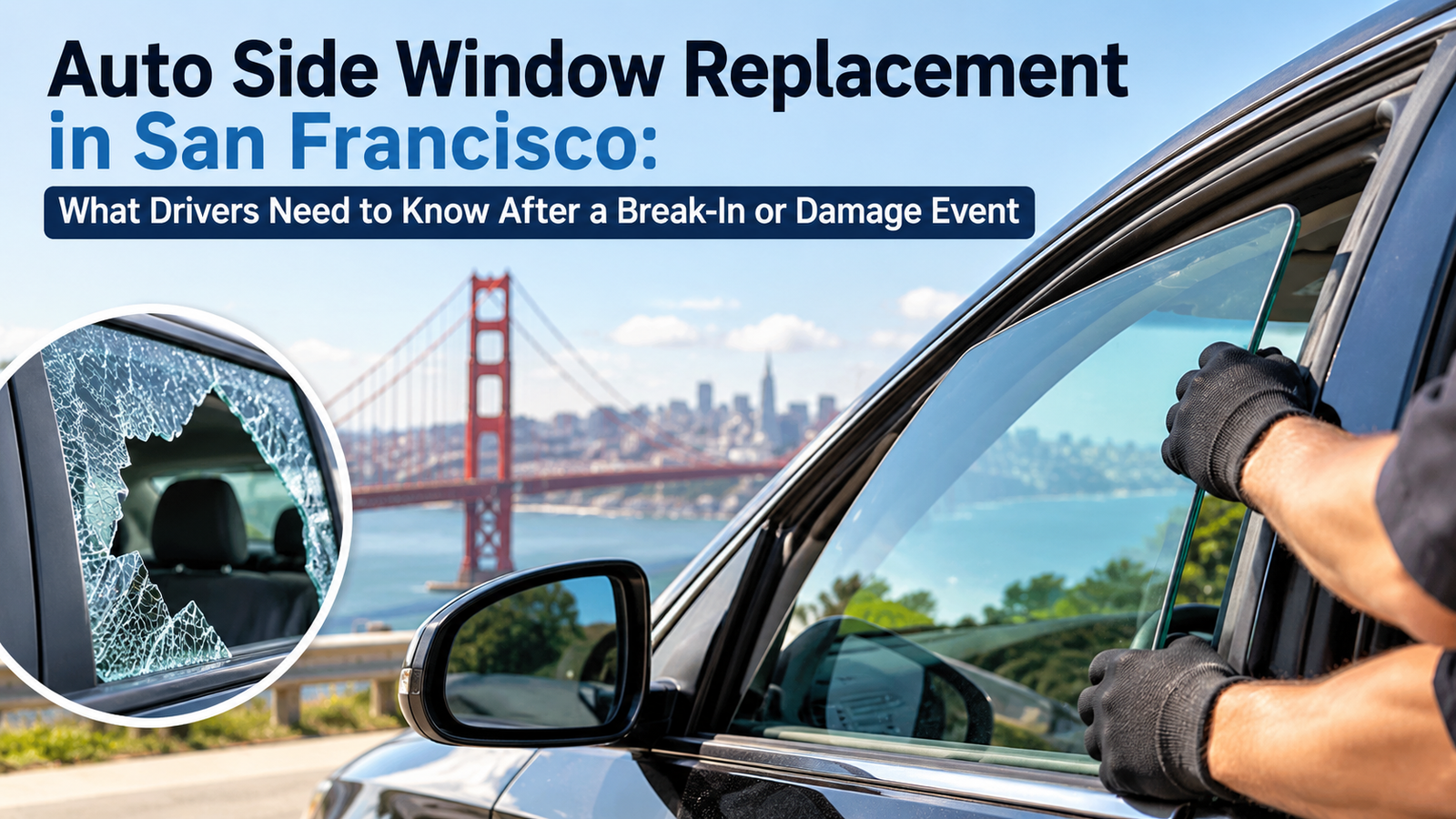
Vehicle break-ins are a defining reality of car ownership in San Francisco. The city consistently ranks among the highest in the United States for reported vehicle break-ins, with certain neighborhoods SoMa, the Mission, the Tenderloin, and many BART and Caltrain station adjacent areas seeing particularly high rates. A shattered side window is one of the most common results of these events, and for San Francisco car owners it can feel like a matter of when rather than if. Understanding what Auto Side Window Replacement San Francisco involves, why it needs to happen promptly, and how mobile service fits into the San Francisco break-in response is practical knowledge for any vehicle owner in the city.
Why Side Window Glass Is Different From Windshield Glass
A vehicle’s side windows the door glass and any fixed quarter glass panels are made from tempered glass, which is fundamentally different from the laminated safety glass used in windshields. Understanding this difference explains both how side windows break and why replacement is the only option when they do.
Tempered glass is produced by heating a glass panel to approximately 620 degrees Celsius and then rapidly cooling it. This thermal treatment puts the outer surfaces into compression and the interior into tension, creating a pre-stressed state that makes the glass roughly four times stronger than annealed glass under normal loading conditions. When tempered glass does fail whether from impact, thermal stress, or spontaneous internal fractures the pre-stressed state causes it to shatter catastrophically into thousands of small, roughly cuboidal fragments rather than the large sharp shards that annealed glass produces.
This shattering behavior is why side window repair is not possible the way windshield chip repair is. Windshields use laminated glass two glass layers bonded by a polyvinyl butyral interlayer that holds together when the outer layer is chipped or cracked, allowing resin injection repair. Side windows have no interlayer to hold fragments in place. Once a side window shatters, replacement is the only path forward.
The Immediate Aftermath: What to Do First
The first concern after a San Francisco vehicle break-in is not glass replacement it is securing the vehicle against further theft and protecting the interior from weather before replacement can be arranged. San Francisco’s marine layer means a vehicle with an open window can accumulate significant interior moisture from overnight fog even on a night with no rain. Leather interiors, electronics, documents left in the vehicle, and any remaining contents are all at risk from fog infiltration.
Standard interim protection uses heavy-gauge clear plastic sheeting and waterproof tape to cover the window opening from inside the vehicle. The plastic should be pressed into the door frame channel if possible, secured with tape on the interior surface of the door above and below the window opening, and stretched to cover the full opening without gaps. This is a temporary measure not a security barrier but it prevents weather from entering.
Document the damage with photographs before any cleanup. Insurance claims benefit from photographic documentation of the damage as found. Contact your insurance company promptly after the incident to report the claim and understand the coverage and process.
Before cleaning up the glass fragments from the seat and floor, check whether any of the thousands of small fragments have spread to locations that might create future problems: in the door pocket, in seat adjustment mechanisms, in the space between the seat and center console, in floor vent openings, and in any compartments that were open during the incident. Tempered glass fragments are small and can be remarkably far-flung a methodical cleanup including vacuuming these secondary locations prevents the ongoing discovery of glass fragments days after the replacement.
How Side Window Replacement Works
Side window replacement is a more straightforward technical process than windshield replacement it does not involve structural adhesives with cure time requirements, and it does not trigger ADAS recalibration needs in most vehicles. The replacement process typically involves the following sequence.
Door panel removal is the first step for most vehicles. Side windows are installed within the door from the inside, and accessing the window frame, regulator attachment points, and channel guides requires removing the interior door panel. The door panel is removed carefully to avoid breaking the plastic clips that secure it clips that are often brittle in older vehicles.
Glass fragment removal clears the door cavity of all remaining tempered glass fragments from the shattered original window. This requires careful vacuum work in the door cavity where fragments collect in tracks, at the bottom of the door, and in any recesses of the door’s internal structure. Incomplete fragment removal leads to the grinding sounds and track damage that occur when fragment-contaminated tracks try to operate with new glass installed.
Window regulator and motor inspection occurs while the door is apart. The regulator and motor that operate the window are inspected for damage from the break-in event particularly if glass fell into the mechanism. If the regulator or motor shows damage, it should be addressed before the new glass is installed.
New glass installation positions the replacement panel in the door, connects it to the regulator attachment points, and seats it in the window tracks and frame channels. The window is then operated through its full range to confirm smooth movement without binding, grinding, or misalignment.
Door panel reinstallation completes the service. The panel is clipped back into position, electrical connections for power windows and door lock switches are reattached, and the window is tested again with all electronics reconnected.
OEM vs. Aftermarket Side Glass in San Francisco
San Francisco’s late-model vehicle population reflecting the city’s tech-affluent demographics includes a high proportion of premium and luxury vehicles where OEM (Original Equipment Manufacturer) glass is the appropriate specification. OEM side glass matches the original glass in thickness, tint characteristics, acoustic properties, and any specialized coatings. For standard vehicles, quality aftermarket glass from reputable manufacturers provides equivalent fit and function. The distinction matters most for vehicles with acoustic side glass a feature increasingly common in premium vehicles where the side windows use a laminated construction specifically for sound insulation.
Mobile Side Window Replacement in San Francisco
Mobile replacement service is the most practical delivery model for San Francisco side window replacement. The vehicle with a shattered window and only plastic sheeting protecting it should not be driven across the city to a shop if it can be avoided. Mobile service addresses the problem wherever the vehicle is: at the owner’s residence, at their workplace, in a parking structure, or at any accessible location. Same-day service is available in most cases for standard vehicle side windows through mobile services operating in San Francisco.
Frequently Asked Questions About Side Window Replacement in San Francisco
How long does side window replacement take? A standard power window side glass replacement by a mobile technician takes 1 to 1.5 hours at the vehicle’s location. Fixed quarter glass panels without regulators are faster. Vehicles with complicated door electronics or rare glass configurations may take longer.
Does California insurance cover side window replacement from a break-in? Yes. Vehicle break-in damage including shattered side windows is covered under comprehensive auto insurance. California’s comprehensive deductible applies. Contact your insurer promptly after the incident to initiate the claim.
Can I drive my vehicle with plastic sheeting over the window? Driving with plastic sheeting is a temporary measure for short necessary trips not a safe long-term solution. Plastic sheeting reduces visibility through the affected window, can come loose at highway speeds, and provides no meaningful security protection. Schedule replacement as quickly as possible.